Service and coverage clarity
Service pages explain the HVAC work you approve and the coverage areas you actually supply, without fabricated local claims.

HVAC website design // Upstate SC
The website explains where you work, what you handle, why a prospect should trust the next step, and how a new inquiry reaches the same lead-recovery workflow.
// conversion foundation
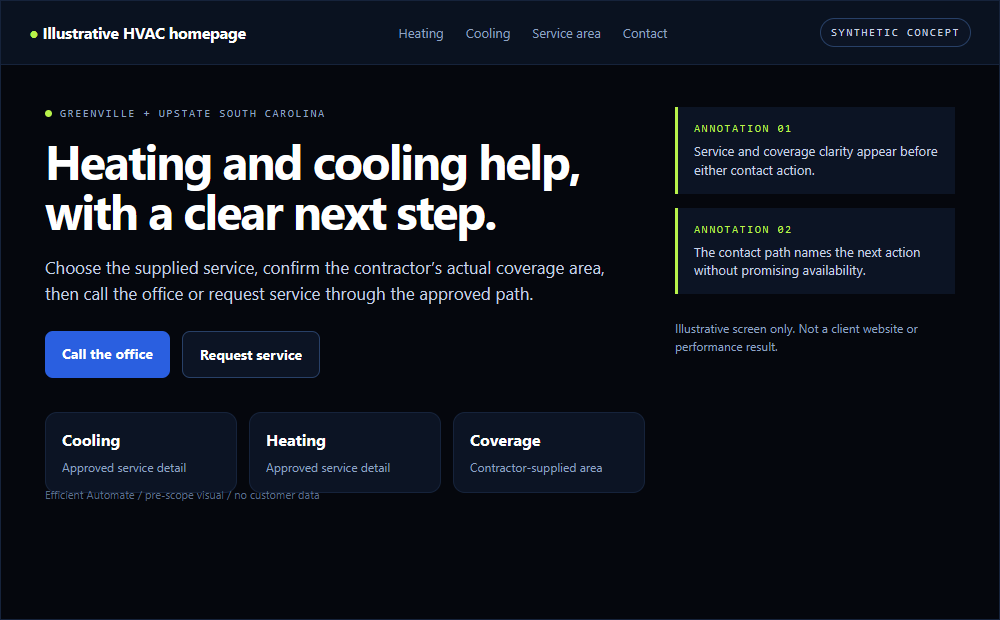
Service pages explain the HVAC work you approve and the coverage areas you actually supply, without fabricated local claims.
Approved click-to-call, form, and contact paths make it clear where an inquiry goes and who receives it.
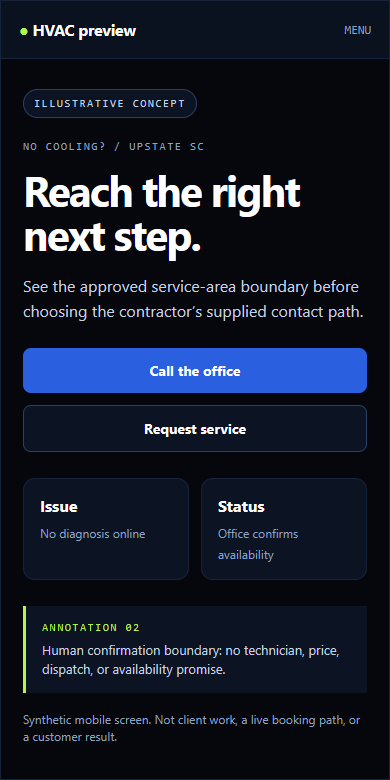
Layouts, assets, and actions are built for the constrained screen where a homeowner often makes the first decision.
Credentials, process details, and customer proof appear only when they are supplied and supportable.
// illustrative screen review
These annotated screenshots are locally captured browser renderings, not a client website, live conversion result, or promise that every scope uses this layout.
// delivery contract
The signed scope lists the approved pages, forms, contact paths, copy inputs, metadata, handoffs, and final files. Unlimited pages and unbounded content are not included.
The client should control its domain and core business accounts. Client-supplied assets remain client property; source-file delivery, access, content rights, and third-party licenses are recorded in the signed agreement.
No universal delivery date is promised. Milestones depend on the agreed page scope, usable content, account access, review cycles, and timely client approvals.
Before replacing an existing site, the agreed migration inventories current URLs, preserves required content, records redirects, and confirms domain and hosting access. Unsupported platforms or inaccessible accounts require a revised scope.
The supplied click-to-call number, approved form, and handoff destination are checked on mobile. No phone number or destination is invented when the client has not supplied and approved it.
Acceptance records the agreed pages, responsive layouts, keyboard path, local links, metadata, forms, handoffs, and measured performance conditions. No universal performance score, ranking, traffic level, or booking outcome is promised.
// handoff and discovery
New inquiries can reach the approved booking flow or the same bounded missed-call recovery path when a call goes unanswered.
The initial build covers crawlable structure, page intent, metadata, internal paths, and performance-minded delivery.
Forms, scheduling, CRM, and phone integrations are included only after permissions, data handling, reliability, and fallback behavior are verified.
Semantic structure, keyboard access, readable contrast, and clear controls remain part of the implementation review.
// scope boundary
No client outcomes are claimed yet, so the proof on offer is inspectable engineering instead: every release of this site must pass 86 automated checks covering performance budgets, byte-pinned stylesheets and media, structured data, and identity claims before it can deploy. A client engagement inherits the same discipline — documented scope, verifiable states, no silent changes. The dated PageCraftory web-design inspection shows the standard applied to a real public build.
Design, rankings, traffic, and booked work are not guaranteed. The work is a scoped website and lead-handoff implementation with agreed acceptance checks, not a claim about results outside that scope.
// connected journey
// field notes
Bring the current service pages, coverage rules, contact paths, and lead-handoff process to a focused fit call.
Book a 20-Minute Fit Call